
KDOC Releases for Smith County Cases
The Kansas Department of Corrections is a statewide prison and post-incarceration supervision system. It is not a second Smith County jail, and no Kansas state prison is located in Smith County. A person sentenced by a Smith County court to the Secretary of Corrections can be assigned wherever KDOC has an appropriate placement.
After physical prison custody, the record may show parole, conditional release, or postrelease supervision. Each means confinement ended while legal supervision continued. Maximum discharge or sentence expiration is the later point when KDOC authority ends. A person can live or report outside Smith County, so conviction county should not be treated as a release destination.
| KDOC status | Custody meaning | What it does not prove |
|---|---|---|
| Incarcerated | Physical state-prison custody continues | A projected date is not actual release |
| Parole or conditional release | Prison custody generally ended; supervision remains | Full sentence discharge |
| Postrelease supervision | Guidelines prison portion ended; community supervision remains | That a parole board granted release |
| Discharged or expired | KDOC sentence authority reached its endpoint | Details of an unrelated county or federal case |
Search KASPER Release Records
The Kansas Adult Supervised Population Electronic Repository, known as KASPER, includes people sentenced to the Secretary of Corrections since 1980. Its scope includes people now imprisoned, people under post-incarceration supervision, and people discharged. A local Smith County bond-out who never entered KDOC authority may not appear.
- Open the KASPER disclaimer and read its scope and update warning before accepting.
- Search by KDOC number when known. It is safer than relying on a common name.
- Otherwise use exact name and narrow the results with alias, date of birth, age, race, gender, KBI number, or conviction county.
- Compare identity, conviction, county, case, and sentence details before selecting a record.
- Read current status and location separately from anticipated release, parole eligibility, conditional release, and sentence expiration.
- If documentary proof is required, request the movement, release, supervision, or discharge record from KDOC.
KASPER updates information each working day, so a recent change can lag. Community-corrections probation events after April 21, 2021 cannot currently be displayed according to the disclaimer. Interstate compact location details may also be restricted. Active supervision should be confirmed with the listed office.
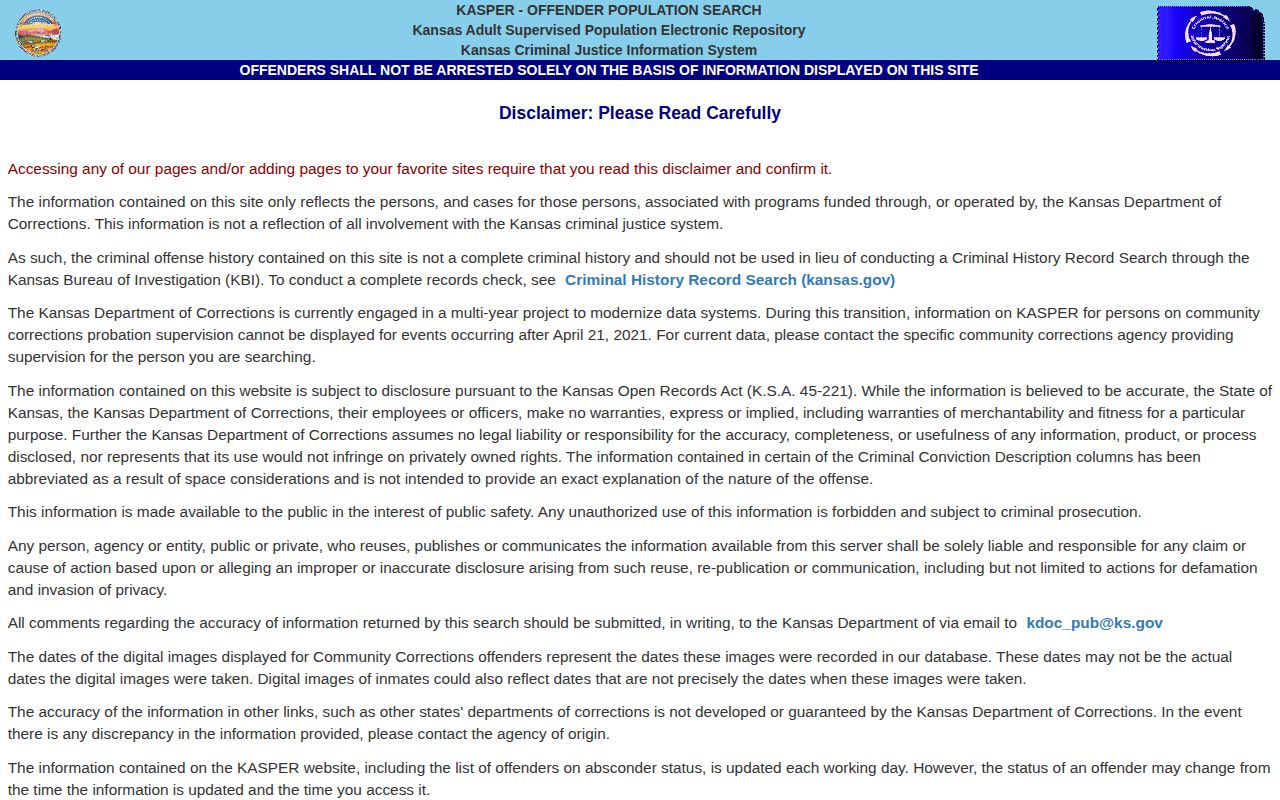
The captured disclaimer below documents the system's statewide scope and limitations.
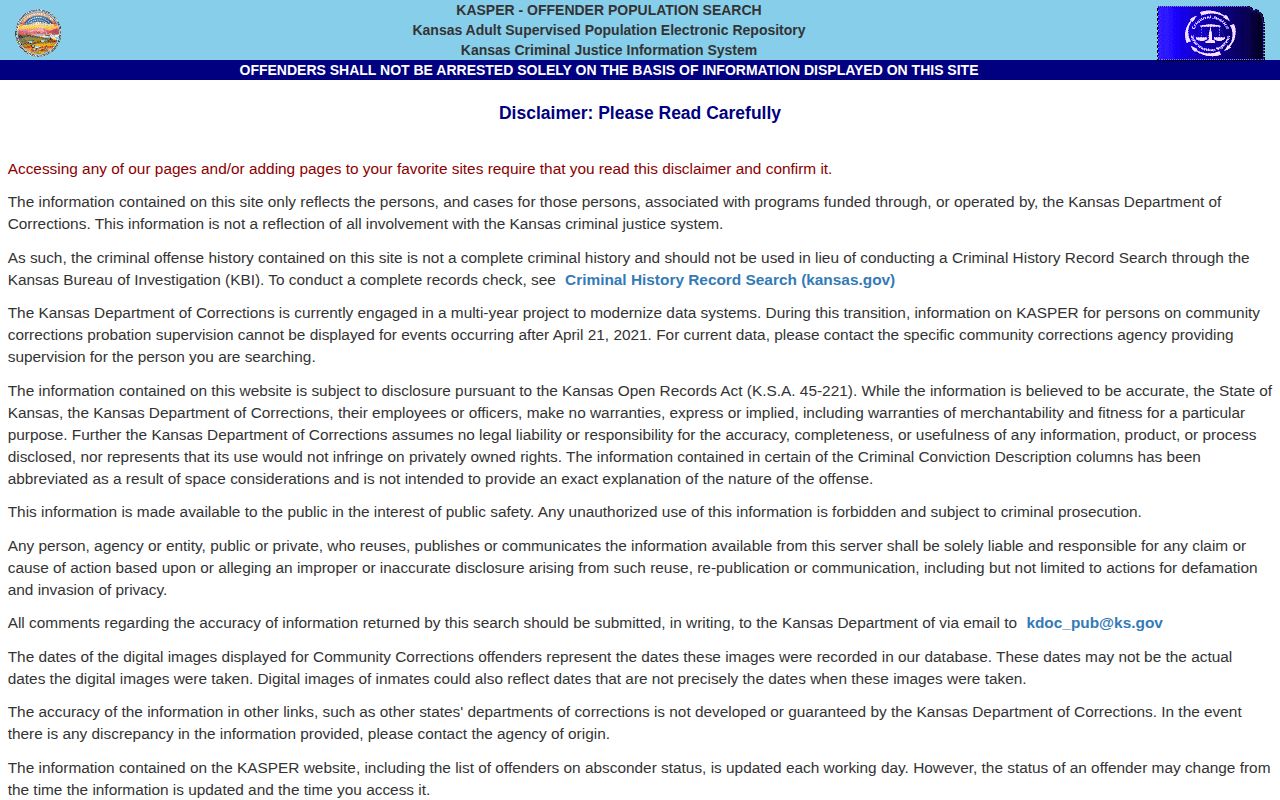
This official entry is the proper starting point for a Smith County state-prison history, not for an ordinary jail-only booking.
KASPER Smith County Release Fields
KDOC identifies a broad set of public offender fields. They answer separate questions and should not be collapsed into a single “release date.”
| Field | What it shows |
|---|---|
| KDOC number and identity | The state correctional record and identifying details |
| Conviction county and case | The court origin, which may be Smith County |
| Current location and movements | Facility or supervision placement and dated changes |
| Anticipated Guidelines Release Date | A current sentence calculation, not a guaranteed exit |
| Parole eligibility | When an eligible case may be considered, not a grant |
| Conditional release or postrelease | Community phase after physical prison confinement |
| Expiration or maximum discharge | The endpoint of KDOC sentence authority |
| Supervising parole office | The office handling an active community status |
The KASPER search form offers basic name and KDOC-number fields, photo options, and advanced controls. The captured form below shows the official route.
Use the added fields to avoid a false match. A photograph can aid comparison, but it is a correctional image and may not be the Smith County booking photo.
KDOC Release and Discharge Records
KASPER is a public search, while a formal KDOC record supplies documentary confirmation. Use the KDOC GovQA public-records portal or contact the department at its Topeka headquarters. Identify the person by full name, KDOC number, date of birth when needed, conviction county, case number, and date range.
Kansas Department of Corrections714 S.W. Jackson, Suite 300
Topeka, KS 66603
Phone: 785-296-3317
Records requests: KDOC GovQA portal
Ask for the existing movement, release, or discharge record; the relevant sentence-computation fields; current or ended supervision status; and an available correctional photograph if needed. KDOC's public inventory includes sentence structure, sentence-begins date, movements, supervision office, and key date fields. Treatment information and other protected content may be excluded.
KORA requires agency action by the end of the third business day, but that is not a guaranteed production date. A response may give the cause for delay and earliest availability. The agency need not create a custom narrative. If KASPER data appears wrong, its published correction channel is kdoc_pub@ks.gov.
KDOC Projected and Actual Release
“Anticipated Guidelines Release Date” is KDOC's exact projected-date label. It is an agency calculation rather than a promise. Good-time awards or losses, program credits, jail credit, consecutive or concurrent terms, court changes, new sentences, revocation, warrants, escape, and absconder time can move the value.
Many Kansas guidelines sentences lead to mandatory postrelease supervision rather than a parole hearing. Older indeterminate and certain off-grid cases may use parole eligibility. Eligibility permits Board consideration; it does not show that release was granted or processed. A scheduled hearing, a Board decision, community-supervision status, physical release record, and final discharge are distinct milestones.
- Projected release
- A current estimate based on sentence data and credits.
- Parole eligibility
- The point when an eligible case may be considered by the Prisoner Review Board.
- Postrelease supervision
- A mandatory community phase following the prison part of many guidelines sentences.
- Maximum discharge
- The later end of KDOC sentence authority.
For a detailed date calculation, use the Smith County inmate release date process. County-jail sentences do not use KDOC calculations unless KDOC has authority over the person.
Smith County Post-Prison Supervision
KDOC's current parole-office table routes Smith County coverage to Northwest Kansas Community Corrections in Hays. Search KASPER first, then contact the office when an active record shows supervision but the reporting location is unclear. Residence and supervision can transfer across counties or states.
Northwest Kansas Community Corrections117 E. 13th St.
Hays, KS 67601
Phone: 785-625-9192
Parole, postrelease supervision, conditional release, court probation, and community corrections are legally distinct. Kansas does not provide one public name directory for all ordinary probationers comparable to KASPER. A Smith County probation question may require the district court case plus the proper Court Services or community corrections office.
KASPER also has parole and community-corrections absconder searches. A Smith County filter can indicate the last supervision location before absconding, not conviction county, residence, release date, or current whereabouts. The listing itself is not authority for a private person to detain anyone.
KDOC Release Notification Boundary
Kansas VINE covers adult offenders in participating county jails and expressly excludes KDOC state-prison residents. A person in Smith County Jail belongs on the county VINE route if the jail participates. A state prisoner or KDOC-supervised person belongs on the separate KDOC Victim Services notification form.
KDOC Office of Victim Services can be reached at 1-866-404-6732 or VictimWitness@doc.ks.gov. The form does not cover an ordinary county-jail offender, probationer, or community-corrections client outside KDOC authority. Choose the channel based on the agency that has custody or supervision.
The captured form below illustrates this distinct state correctional notification path.
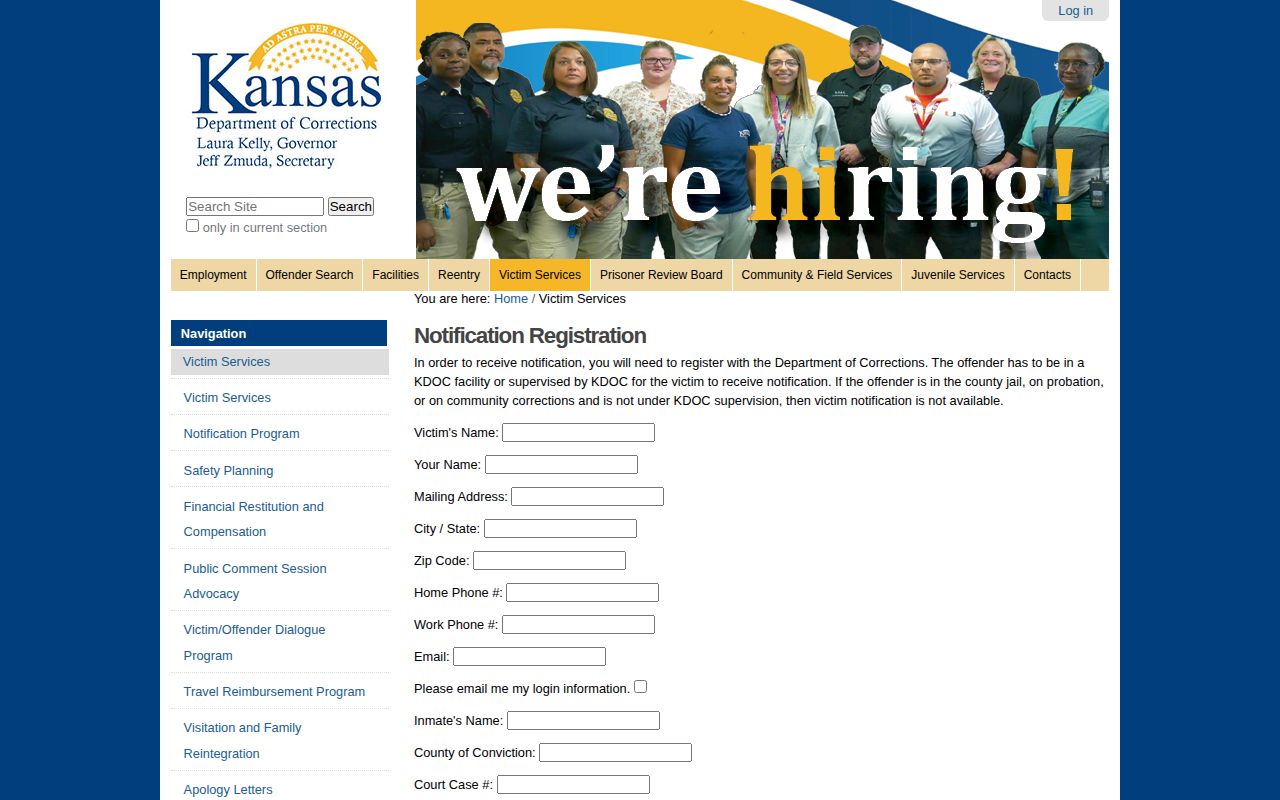
The separate route prevents a common error: searching county VINE for a KDOC resident and treating no result as release.
After a Smith County KDOC Release
A Smith County conviction does not require return to Smith County. Release planning, approved residence, supervision placement, interstate transfer, family ties, and other lawful arrangements can place a person elsewhere. KASPER's current location or supervising office is more useful than an assumption based on the original court.
If KASPER shows discharge, KDOC authority has reached its endpoint for that sentence. It does not rule out a separate county, federal, immigration, or court matter. If the person first left Smith County Jail for KDOC, the county event was a transfer. The later KDOC movement and discharge records establish the state-prison outcome.
Note: Always match the search to the custody system; Smith County Jail records and KDOC records document different stages.