
Smith County 72-Hour Release Window
The Smith County Sheriff provides no official 72-hour release view. Its jail page contains operating and bond information, not a current roster or a released-person database. No distinct feed URL, rolling-window definition, update cadence, photo field, or retention promise exists.
A three-day inquiry still has a valid purpose. It can cover a weekend, bridge uncertainty about the actual departure day, or include a release authorized on one date and processed on another. Yet it must be directed to the record custodian. A web search cannot reveal a list the county never published.
Check Smith County Three-Day Releases
Build the request around exact calendar boundaries. “The last 72 hours” moves every minute, while a jail log may be arranged by date or shift. Give the beginning and ending date and state that the time is local. If the question concerns one person, include enough detail to separate people with similar names.
- Set the window. Write down the exact local start and end dates and times for the three-day span.
- Call the jail. Contact the Smith County Sheriff at 785-282-5180 and ask whether an existing release or movement log covers that period.
- Narrow the identity. Supply a full name, approximate booking date, birth date when needed, case number, or booking number.
- Ask what ended. Determine whether Smith County custody ended through community release or transfer to another authority.
- Define the recorded time. Ask whether it reflects authorization, administrative completion, physical exit, or receiving-agency acceptance.
- Seek the source record. Request the booking/release entry and release instrument rather than asking for a newly compiled report.
When the event is clearly same-day, the Smith County Released Last 24 Hours guide gives a tighter workflow and covers pickup and transportation issues.
Smith County Three-Day Record Fields
Smith County shows no three-day fields online. The relevant information must come from an existing jail record, court record, or receiving-agency record. The table identifies useful fields to describe in a focused request without implying that each item appears in one document.
| Field to request | Why it matters |
|---|---|
| Full name and booking number | Connects the movement to the correct local booking. |
| Booking or arrest time | Separates an older custody event from one within the selected period. |
| Custody-end date and time | Places the event inside or outside the defined three-day window. |
| Legal manner of release | Distinguishes bond, own recognizance, time served, court order, transfer, or another recorded outcome. |
| Release instrument or order | Shows the authority filed for the custody change. |
| Destination or receiving authority | Reveals whether the person entered another custody system rather than the community. |
| Case and charge references | Connects the jail event to the district or municipal court path. |
Note: Smith County publishes no online field set, cadence, photo flag, or retention period for a 72-hour release list.
Smith County Weekend Release Timing
A three-day span is most useful as a records boundary, not as proof that Smith County follows a special weekend publication cycle. The Sheriff posts no release-processing hours or weekend and holiday schedule. The website also does not identify an exit door, waiting area, property-return process, or a time when a daily log closes.
Do not infer a Saturday or Sunday release from the date of a court order alone. Authorization may precede jail processing, and physical departure may occur later. The jail movement entry is the better source for when local custody actually ended. If another agency accepted the person, its record can establish the next custody stage.
The absence of a public feed means there is no “next day’s list” to wait for. Call the jail for a current answer, then request the record if the timing or nature of the event needs to be documented.
Obtain Smith County Release Records
The direct fallback begins with the Sheriff as custodian of jail records. Smith County publishes a general open-records policy and request form, but no Sheriff-specific records email or records hours. Call first to confirm where to send the request and obtain a cost estimate.
Ask for an existing release or movement log for the exact period if one exists. If the real need concerns one person, request that person’s booking/release entry and release instrument instead. KORA does not compel the agency to create a custom three-day list by combining unrelated files. Fees and exemptions can apply, and a custodian may provide segregable public parts while withholding protected content.
K.S.A. 19-1911 addresses release and commitment instruments. The legal instrument can explain the authority for a custody change, while the jail entry can establish when staff executed it. A clear request seeks both without asking the Sheriff to draw a conclusion that the records themselves can answer.
No Smith County Release Archive
Smith County publishes neither a current inmate roster nor a recent-release archive. That means a researcher cannot compare a name across yesterday’s roster and today’s release list. There are also no county release cards, booking photographs, downloadable logs, or stated online retention periods to evaluate.
A disappearance from any unofficial list is only a change signal. It may reflect release, transfer, delay, a spelling difference, or the list’s own data limits. If the Sheriff confirms that no releasable log exists for the requested span, stop there. A third-party recent-bookings page is not an acceptable substitute because bookings show who entered custody, not who left it.
The official Smith County Jail page is the matched source for the absence of release controls:
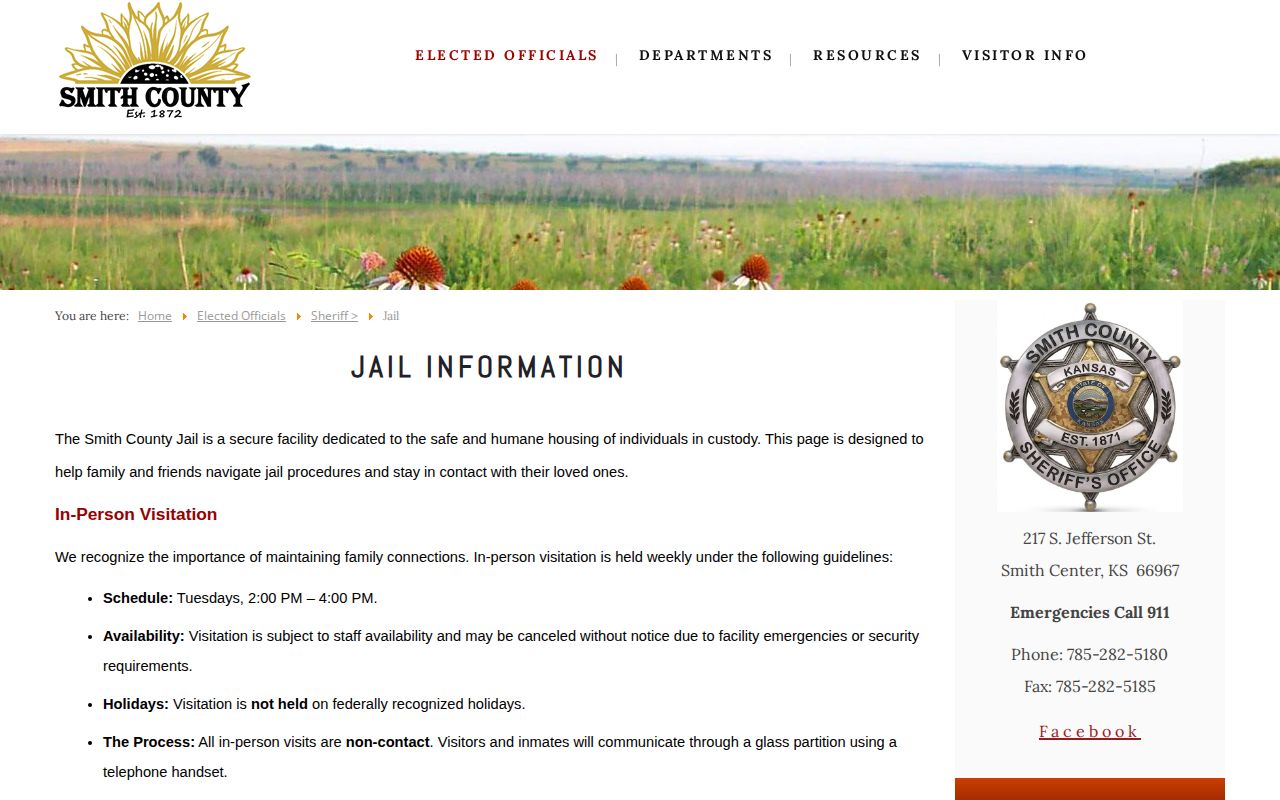
The page supports direct contact and bond research, but it does not display a 72-hour record set or identify recently released people.
Smith County Named-Person Check
A request for one person is different from a request for every release in three days. It is usually easier to identify and may avoid producing unrelated personal details. Give the person’s full name and an approximate booking date, then add a case or booking number if available.
Ask whether the record reflects community release, a transfer, or continued local custody. If the answer remains unclear, the complete Smith County released-inmate lookup routes a named case through the jail, state court, Smith Center Municipal Court, Kansas corrections, federal custody, and immigration custody as applicable.
Note: A named-person inquiry and a three-day log request answer different questions and may locate different existing records.
Trace Smith County Custody Changes
When Smith County confirms a transfer, follow the named authority instead of labeling the person released. KASPER covers people associated with Kansas Department of Corrections custody or funded programs. A local bond-out may never appear there. For a KDOC person, compare the status, current location, sentence fields, and any post-incarceration supervision entry.
Kansas VINELink covers adult offenders in participating county jails and excludes KDOC prison residents. A VINE alert can flag release or transfer when registration took place before the event, but the system is not a promised permanent archive. A missing result can reflect timing, identity, transfer, release, or system scope.
For federal custody, the BOP Inmate Locator can show a past release date and “Released” or “Not in BOP Custody.” ICE says its locator includes current detainees and people released from ICE custody within the last 60 days. Neither system proves what happened at Smith County Jail unless the Sheriff identifies that receiving path.
Match Smith County Court Authority
A district-court docket can supply the bond order, disposition, sentence, dismissal, or revocation behind a release. Search the Kansas District Court Public Access Portal by name or case number and filter to Smith County. Some records remain available only at a courthouse terminal, while sealed, expunged, juvenile, adoption, grand-jury, and other protected records are excluded.
Smith Center Municipal Court is a separate path for city matters. Its published schedule uses the third Thursday of each month unless otherwise stated. If the source of release authority is unclear, ask the jail which court or agency supplied it. An empty statewide portal search does not prove there was no municipal matter or custody event.
Confirm the Smith County Outcome
The most reliable three-day result combines records that answer different parts of the question. The jail entry establishes whether and when Smith County custody ended. The release instrument or court order identifies legal authority. A receiving-agency record shows whether the person remained in custody elsewhere.
Use the narrowest evidence that resolves the issue. A VINE alert is a lead. KASPER can document state custody or supervision. A BOP or ICE result applies only to its own system. None should be stretched into proof that every form of custody ended. Maximum discharge is also different from physical release because community supervision may continue after incarceration.
Note: The phrase “released in 72 hours” should describe a verified local custody event, not an assumed community outcome.