
Smith County VINELink Release Coverage
Kansas VINE, or Victim Information and Notification Everyday, covers adult offenders held in participating Kansas county jails. The Kansas Attorney General’s VINE page expressly excludes residents of Kansas Department of Corrections prisons. That line matters in Smith County. VINELink is the notification route for a person held in participating county-jail custody, while KASPER and KDOC Victim Services are the correct state-prison routes.
VINE is free, confidential, and voluntary. State materials describe internet, telephone, mobile-app, and TTY access, plus phone, email, text, and in-app alerts. It is a custody notification service, not a permanent archive of Smith County releases. No state source promises how long a released record remains visible. Registering before the expected event provides more useful evidence than trying an empty search after the person has left.
The Attorney General provides an implementation map for participating counties. Its current status should be checked when a Smith County search is made because participation and live presentation can change. Even in a participating county, VINE reports data supplied through the custody system. It does not replace the Sheriff as keeper of the local booking and release entry. If the live Kansas map or search does not expose the expected Smith County record, call the jail before drawing a conclusion.
| Custody system | Correct notification path | What to confirm |
|---|---|---|
| Participating county jail | Kansas VINELink | Identity, facility, custody status, and later alert |
| KDOC prison or KDOC supervision | KDOC Victim Services | State custody, movement, supervision, or discharge |
| Federal BOP | BOP Inmate Locator and federal records | Federal release date or “Not in BOP Custody” status |
| Smith County Jail record | Smith County Sheriff | Whether the event was community release or transfer |
Search a Smith County VINELink Record
Open the Kansas VINELink landing page and use the current “Find an Offender” control. A full name and date of birth can narrow the result. An inmate or offender identifier is stronger when available. Similar names are common, so do not select a record from name alone. Compare the facility and every displayed identity field before treating the result as the right Smith County person.
- Select Kansas on VINELink and open the offender search.
- Enter the person’s name and date of birth. Add an inmate identifier when it is known.
- Review all matches and compare identifying facts rather than relying on spelling alone.
- Open the best match and read the listed facility and current custody status.
- Register from the custody record while the person remains held.
- When an alert arrives, call the Smith County Jail to classify the event as release, transfer, escape, or another custody change.
The successful manifest capture below shows the official Kansas landing screen. It identifies the state service readers should use and avoids the common error of relying on a generic or out-of-state result.
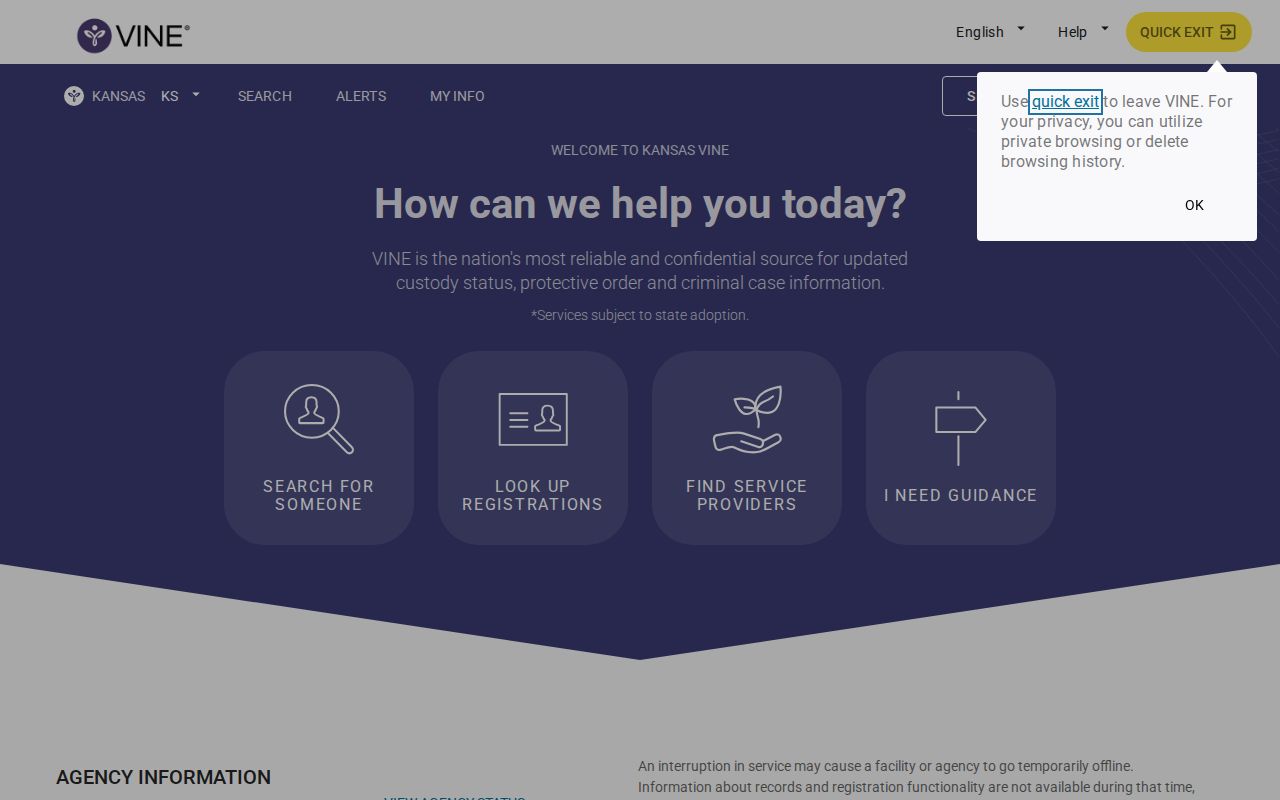
The landing screen begins the person-level search, but the matching custody record and the jail’s own release entry provide the facts needed for confirmation.
Smith County VINELink Release Fields
VINELink presentation can change, and the Smith County research did not establish a fixed person-record field inventory or a released-record retention period. The person workflow depends on the core facts shown by the live matching record: identity, facility, custody status, and the notification control. Read each field in its narrow sense. A facility name shows which agency supplied the custody record. A status describes the reported custody state at the last update. Neither field explains the full court result or all legal duties after release.
| Field or control | How to use it |
|---|---|
| Name and identity details | Compare the result with known facts to avoid a same-name mismatch. |
| Inmate or offender ID | Use it as a stronger person match when the number is known. |
| Facility | Confirm that the record comes from the expected county jail. |
| Custody status | Read the reported state, then verify any change with the holding agency. |
| Notification registration | Select alert channels while the person is still in custody. |
A missing Smith County result is ambiguous. It may reflect a spelling error, identity mismatch, delayed data, transfer, release, nonparticipating custody, a system outside VINE, or a display limit. It does not prove release. If the person was held at Smith County Jail, call 785-282-5180 and ask whether the record shows continued custody, community release, or transfer to a named authority.
Set Smith County Release Alerts
Registration generally must occur while the person is still held. From the matching VINELink record, choose one or more available channels. Kansas materials support phone and email and also describe text and in-app alerts. Use a direct telephone number, not a switchboard. A switchboard may prevent the automated call from reaching the registered person or accepting the acknowledgment.
- Locate and confirm the correct county-jail record before release.
- Select each phone number or email address that should receive notice; use text or app alerts if the live service offers them.
- Create and retain a four-digit PIN for telephone registration. Email registration does not require that PIN.
- When VINE calls about a release or other change, listen to the full message.
- Enter the four-digit PIN followed by the pound key to acknowledge the call.
- If the PIN is forgotten, call the brochure-supported line at 1-866-574-8463 and press zero for help.
A correct phone acknowledgment stops repeat calls. If the call is not acknowledged, VINE may leave a message and keep calling for up to 24 hours. The official Kansas brochure supports 1-866-574-8463, which matches 1-866-KS-4-VINE, and TTY 1-866-847-1298. The Attorney General webpage displayed a different digit sequence during research. The brochure-backed number is used here because it agrees with the mnemonic and the official brochure.
Alerts can report a release, transfer, escape, or another custody change. Listen to the event type. A transfer means one agency’s custody ended because another agency took over; it is not a confirmed return to the community. Ask the Smith County Jail for the receiving agency when an alert or other clue points to transfer.
The alert does not state every legal effect of the event. Bond release may end jail custody while the court case and release conditions remain active. A transfer to KDOC may end the Smith County Jail record while prison confinement continues elsewhere. A release from KDOC to postrelease supervision ends the prison portion but not the sentence. Match the notification with the jail movement entry, court order, KASPER status, or receiving-agency record that fits the custody path.
Smith County VINE or KDOC
Kansas has an unusually clear notification boundary. County VINE covers participating county jails but excludes KDOC state-prison residents. KDOC maintains its own victim-notification registration for a person in a KDOC facility or supervised by KDOC. That state form does not cover an ordinary county-jail offender, probationer, or community-corrections client outside KDOC authority.
For a KDOC prisoner, search KASPER to check the state status and use the separate notification form, call 1-866-404-6732, or email VictimWitness@doc.ks.gov. A person under parole, conditional release, or postrelease supervision may remain within KDOC authority even though physical prison custody ended. County VINE and KDOC notification cannot be used as if they were one statewide record.
The official KDOC form capture below documents the separate state-corrections channel. The holding system, not the person’s Smith County connection, determines which notification process applies.
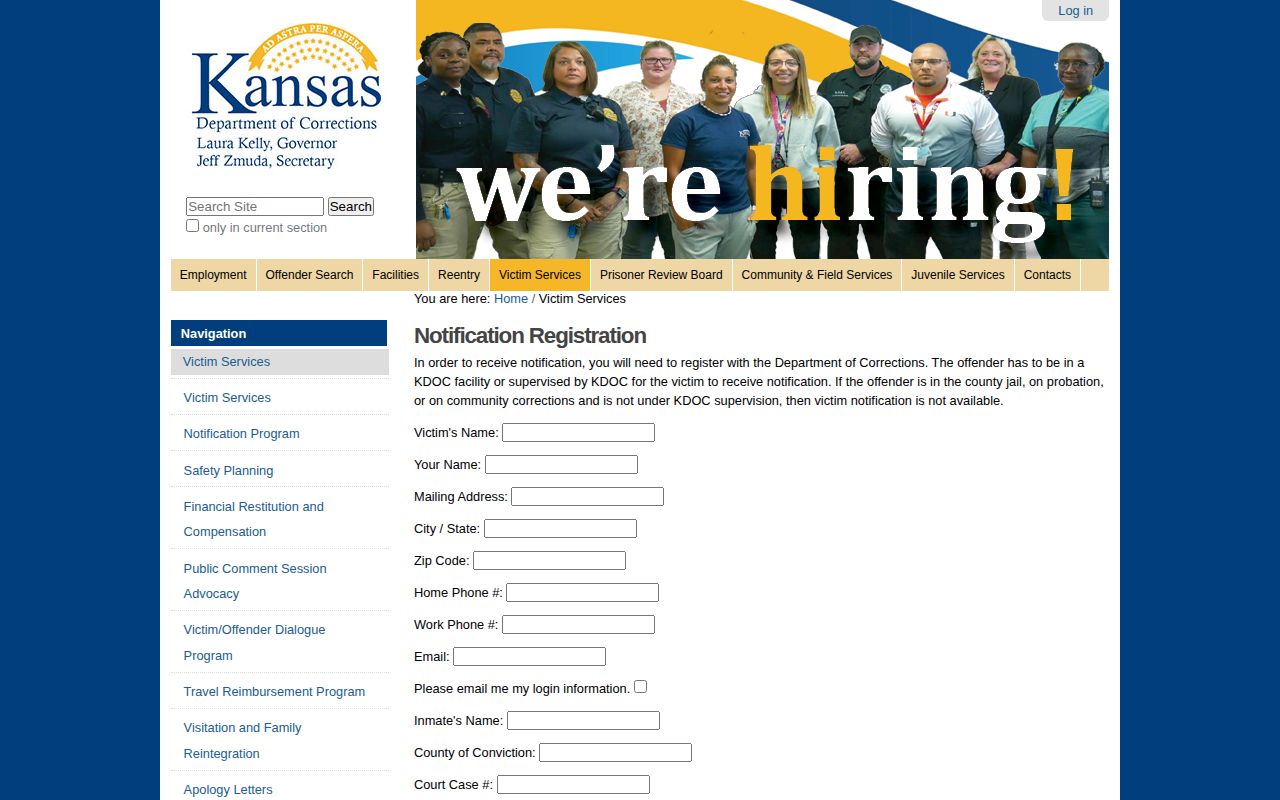
This boundary prevents a county VINELink search from being mistaken for a complete Kansas prison search.
Confirm Smith County Release Alerts
A VINE notice is a useful lead, not the full legal record. For a Smith County Jail event, call the Sheriff and ask whether custody ended through bond, own recognizance, time served, a court order, transfer, or another recorded disposition. The jail release entry supplies the actual custody-end event. The court file can then supply the bond order, dismissal, sentence, or other legal authority.
If the person moved to KDOC, use KASPER. If federal authorities took custody, use the BOP locator or the named federal system. A county-jail departure to another agency does not prove community release. VINELink also does not replace the formal booking and release record when a document is needed for a court or records matter.
A focused Sheriff request can identify the person by full name, approximate booking date, case number, or booking number. Ask for the existing booking and release entry, the date and time custody ended, the recorded manner of release, and the destination or receiving agency if it was a transfer. Ask for the release instrument as well. Kansas law does not require staff to create a new report, so naming existing records produces a clearer request than asking staff to explain the whole history.
When the court path is needed, search the Kansas District Court Public Access Portal and filter to Smith County. A bond order, dismissal, sentence, or revocation may explain the authority for a custody change, though it may not show the exact time jail staff completed processing. Smith Center Municipal Court is a separate path for city matters. The jail record is the bridge when the controlling court is not known.
A wider Smith County search path, including jail records, court records, KASPER, federal custody, and immigration custody, is available on the Smith County released inmates page. Use that path when no alert was registered or when the person’s custody system is unknown.
Note: Register before the expected change, preserve the alert details, and confirm the custody outcome with the Smith County Jail or the named receiving agency.