
Smith County Parole or Probation
A released Smith County person may appear in several community-status categories. Parole is a discretionary release route for eligible indeterminate or old-law prison sentences. The Kansas Prisoner Review Board decides whether an eligible person is suitable for parole. Postrelease supervision is different. It is the mandatory community portion that follows the prison term for many determinate Kansas guidelines sentences. Conditional release follows a statutory calculation in an indeterminate case. Probation is ordered by a court and commonly serves as an alternative to confinement, so probation alone does not prove that a person left a KDOC prison.
Community corrections is also a court-based supervision structure. In Smith County, the same regional organization may help with both community corrections and contracted parole services, but that shared office does not merge the legal categories. The sentencing order and current KDOC record control the label. Maximum discharge is later still. It means the sentence obligation has ended, not merely that prison custody ended.
| Status | Who authorizes it | What it establishes |
|---|---|---|
| Parole | Kansas Prisoner Review Board | An eligible prison sentence continues under community supervision after discretionary release. |
| Postrelease supervision | Sentence imposed under Kansas law | The prison portion ended, but a required community term continues. |
| Probation | Sentencing court | The person follows court terms, often instead of serving a prison term. |
| Community corrections | Court and regional program | A court-supervision placement is active; it is not automatically parole. |
| Maximum discharge | KDOC or the controlling authority | The sentence and its supervision term have reached their endpoint. |
Check Smith County Supervision Records
Start with the custody path. KASPER, the Kansas Adult Supervised Population Electronic Repository, covers people sentenced to the Secretary of Corrections since 1980, including current prisoners, people under post-incarceration supervision, and discharged people. It does not contain every Smith County jail stay or all ordinary probation cases. A person who posted bond locally and never entered KDOC authority may have no KASPER entry.
- Accept the KASPER disclaimer and search by KDOC number when it is known. A unique number is safer than a common name.
- Otherwise search by name and compare birth date, aliases, conviction county, KBI number, and physical details before selecting a record.
- Read current status and location separately. Parole, conditional release, or postrelease status usually confirms release from physical prison custody, not full discharge.
- Review the listed supervising office. Contact that office when routing is unclear because supervision and residence may transfer.
- For ordinary Smith County probation, check the Seventeenth Judicial District case and contact the appropriate Court Services or community-corrections office.
- Request the formal KDOC release or discharge record when a documented answer is needed.
KASPER says its information, including absconder data, is updated each working day. A status can change after that update. The repository also warns that community-corrections probation events after April 21, 2021 cannot currently be displayed. That gap makes the court case and regional agency essential for some Smith County probation inquiries. A data correction can be sent in writing to kdoc_pub@ks.gov.
Smith County Regional Supervision Office
Smith County does not have a stand-alone local parole office. The KDOC parole-office contact table routes the county to Northwest Kansas Community Corrections in Hays. The regional provider serves several northwestern counties and also performs court/community-corrections work. Search the person’s record first. Then use the office contact to confirm current routing, because a Smith County conviction does not guarantee that the person reports in Smith County or even remains assigned to the Hays location.
117 E. 13th Street
Hays, KS 67601
785-625-9192
The regional governing-board page confirms the local service structure. No universal weekly or monthly reporting schedule is published for every supervised person. KDOC’s supervision handbook says contact frequency turns on assessment and the assigned officer’s direction. Only the assigned office can state the actual reporting terms for a specific case.
The official regional assignment is shown in the source capture below. It supports the Smith County routing described above, but the person-level KASPER record remains the first place to check for a current office.

The image documents KDOC’s county assignment table and helps separate a regional supervision contact from a jail release record.
Smith County Parole Hearing Status
The Kansas Prisoner Review Board is the state parole authority. Its monthly Public Comment Sessions page lists a public-comment event and an offender list for the following month’s parole-eligibility hearings. A list may show a KDOC number, facility, county of conviction, case number, offenses, and the earliest possible release month if parole is granted. County of conviction does not show where the person lives or plans to return.
Three moments must remain separate: public comment, the later eligibility hearing, and the earliest possible release month. A scheduled hearing proves only that review is expected. It does not show a grant or a physical release. Under K.S.A. 22-3717, offense date and sentence structure shape eligibility. Many guidelines prisoners with crimes on or after July 1, 1993 are not parole cases and instead move to mandatory postrelease supervision.
The Board describes three basic outcomes. “Parole” means the Board finds the person suitable for release. “Continue” postpones a decision for more information, evaluation, deliberation, or votes. “Pass” denies parole for a stated period. There is no public person-level decisions database comparable to the future schedule. After a hearing, check KASPER, contact the Board at 785-296-4524, or request a releasable decision or order. Protected preparole and supervision material may be withheld.
KDOC reports parole decisions in aggregate rather than as a public name-by-name results search. Its fiscal-year 2024 report lists 131 grants, 140 passes or denials, and 14 continued or other decisions, for 285 matters including continuances. Those totals describe statewide Board work. They do not resolve any Smith County person’s outcome. The useful proof sequence is the future hearing schedule, a Board authorization, a later KASPER community status, the formal release record, and eventually a maximum-discharge certificate.
- Eligibility
- The point when the Board may consider release; it is not a release order.
- Discharge
- The later endpoint when the controlling sentence and supervision duty end.
- Absconder
- A supervised person who knowingly avoids supervision or makes their whereabouts unknown.
- Revocation
- An official action that withdraws community release and may return a person to custody.
Smith County Parole Absconder Records
Smith County publishes no local warrant or most-wanted directory. KDOC maintains separate public tools for parole absconders and community-corrections absconders. The parole absconder search can filter by Smith County as the last supervision location and can display photographs. That filter describes the office area tied to supervision before the person absconded. It is not a release date, residence, conviction county, or live location.
K.S.A. 75-5217 defines absconding as knowingly avoiding supervision or knowingly making whereabouts unknown. A public entry is not authority for a private person to stop or detain anyone. KDOC warns users not to attempt an arrest based only on its public data. Report nonurgent information to the KDOC Absconder Tips Hotline at 785-746-7620. Immediate danger belongs with 911. Ordinary warrants still require confirmation through the court or Smith County Sheriff.
The official capture shows the Smith County filter, photo controls, and the warning tied to the parole search.
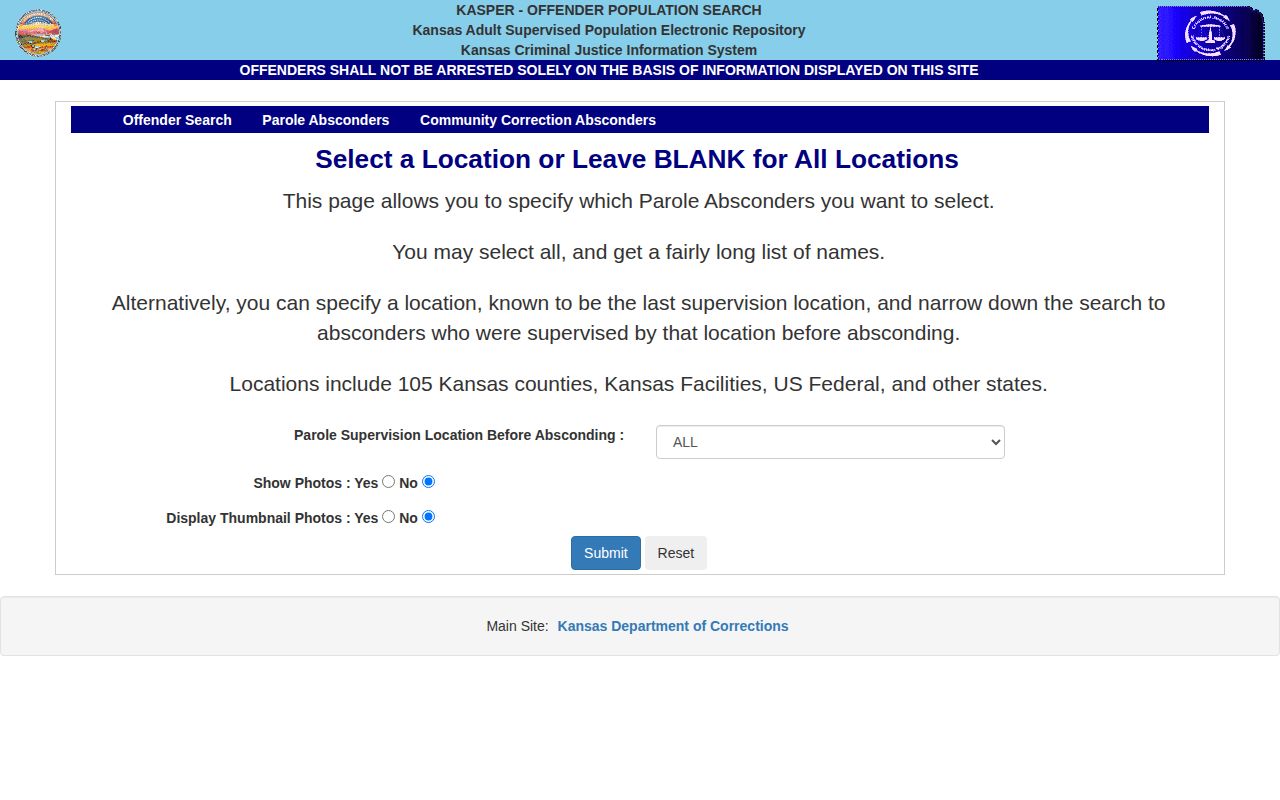
The filter can narrow a public search, but only the responsible agency can confirm a current warrant or supervision action.
Smith County Supervision Changes
Conditions vary by sentence, assessment, and officer direction. Common legal events include a change in reporting office, an interstate transfer, a violation notice, revocation, reinstatement, or final discharge. A Smith County jail release on bond may also carry court conditions, but those are not parole. The district-court case is the sound source for bond and probation orders. KASPER is the sound public source for KDOC status.
The KBI registered-offender search is separate. It applies only to people with a statutory registration duty and is not a general parole or probation list. Registry presence can corroborate a community status for a covered person, while absence says nothing about most released people. Kansas VINE is also separate. It supplies county-jail custody notifications, not routine parole-office updates. State-prison and KDOC-supervised notification uses KDOC Victim Services.
A supervision violation does not establish an automatic return to custody. The assigned authority must assess the alleged conduct and follow the controlling process. Revocation means an official decision withdrew the community placement; it should not be inferred from an old docket entry, a missed appointment rumor, or a stale public status. If a new Smith County court entry appears, compare its filing date and order with the latest KASPER update. For a person on court probation, the district-court record and Court Services route remain more direct than the KDOC parole search.
To verify the end of supervision, look for sentence expiration or maximum discharge, then seek the formal agency record if needed. A complete Smith County release search may also require the local jail release instrument when the person never entered state prison; that broader county process is explained on the Smith County released inmates page.
Note: A parole grant, community-supervision listing, and maximum discharge are three different stages and should never be treated as the same event.