
Smith County Release Paths
A release from the Smith County Jail means that the Sheriff’s physical custody ended. It does not always mean the person walked free. A bond, own-recognizance order, completed local sentence, dismissal, or other court order can return someone to the community. A transfer to the Kansas Department of Corrections, another county, federal authorities, a hospital, or immigration custody ends the local jail stay without ending custody. The jail record is the first place to separate those outcomes.
Smith County has no public online roster or recent-release archive. The official Smith County Jail page gives facility and bond procedures, but it does not identify people who are held or released. Call the jail, ask whether the last movement was a community release or a transfer, and request the record that authorized the change. A person sentenced to state prison follows a separate path through KDOC and KASPER.
Leaving a county roster is only a signal. The release entry, court order, bond record, or receiving agency confirms what happened.
Smith County Release Types
The legal reason for departure controls where the next reliable record appears. “Released” is too broad by itself. These common outcomes should be checked against the Sheriff’s movement entry and the related court case.
| Recorded outcome | What it means | Where to verify next |
|---|---|---|
| Cash or surety bond | Physical jail custody ends after processing, while the case and release terms remain active. | Jail release entry, bond document, and court docket |
| Own recognizance | A judge authorizes release without the full cash bond. | Court order and jail execution time |
| Time served | The local custody term is complete. | Sentence, jail credit, and custody-end record |
| Dismissal or court order | The legal basis for detention changes or ends. | District or municipal court file plus jail record |
| KDOC or agency transfer | Smith County custody ends, but confinement continues elsewhere. | KASPER or the named receiving authority |
| Parole or postrelease supervision | Prison confinement ends while state supervision continues. | KASPER and the assigned supervision office |
Kansas probation differs from parole. Probation is a court-ordered community status, often used instead of incarceration. Parole is a supervised release decision for eligible sentences. Postrelease supervision is a mandatory community phase following many Kansas guidelines prison terms. Full discharge occurs later, when the agency’s legal authority ends.
Smith County Release Record Fields
A focused release-record request should identify an existing document. Smith County may keep the details in more than one file, such as a booking record, movement entry, bond paper, release order, or commitment instrument. K.S.A. 19-1911 requires instruments that commit or release a prisoner from sheriff custody to be filed and safely kept. That instrument is often more useful than an online image, especially because the county has no published roster.
| Field | What it establishes |
|---|---|
| Name and booking number | Connects the event to the correct jail stay. |
| Booking date and time | Marks when local custody began. |
| Arresting agency and case number | Points to the related law-enforcement and court files. |
| Charges and holding authority | Shows the stated legal basis for detention. |
| Bond type and amount | Explains one possible route out of physical custody. |
| Custody-end date and time | Shows when the jail recorded the departure. |
| Manner of release | Distinguishes bond, time served, court order, and other outcomes. |
| Destination or receiving agency | Separates community release from transfer. |
Not every field is guaranteed to exist or be open. Ask for all reasonably segregable portions when some material is withheld. A booking photo is a separate request item. Kansas Attorney General guidance says mugshots and standard arrest reports may be closed at the custodian’s discretion, even though a jail roster can be open.
Request Smith County Release Records
The Smith County Sheriff’s Office is the starting custodian for local jail files. It is at 217 S. Jefferson St., Smith Center, KS 66967, with phone 785-282-5180 and fax 785-282-5185. No sheriff records email, records-unit hours, or guaranteed photo fee is published. Call first to confirm the current custodian and accepted delivery method.
- Identify the person by full name and add a booking date, case number, booking number, or date of birth when needed to distinguish identities.
- Ask for the existing booking and release entries, custody-end date and time, legal manner of release, and the filed release or transfer instrument.
- Request the destination or receiving agency if the departure was a transfer. Ask for the booking photograph separately if it is needed and releasable.
- State a clear date range. Do not ask the custodian to research a broad question or create a new report.
- If material is withheld, request the open portions and a written statement of the legal basis for denial.
The county’s general open-records policy lists letter or legal copies at $0.25 per page, oversize copies at $0.50 per page, faxes at $0.25 per page, CDs at $25, and research or preparation at $20 per hour or the employee’s actual hourly rate, whichever is higher. Confirm whether the schedule applies to the Sheriff’s response. The county form says payment is due on the request date.
Under K.S.A. 45-218, the agency must act as soon as possible and no later than the end of the third business day. That is a response deadline, not a promise of production within three days. A delay response must explain the cause and give the earliest expected availability.
Smith County Record Retention
Online display and legal retention are separate. Smith County offers no public online release window at all. Kansas’s sheriff retention schedule lists arrest records for a minimum of five calendar years in misdemeanor matters and twenty calendar years in felony matters before authorized destruction. Those periods do not require a public web roster, and other holds or schedules can affect a specific file.
Sealed and expunged records can also vanish from ordinary public paths. K.S.A. 21-6614 governs many conviction and diversion expungements, while K.S.A. 22-2410 covers qualifying arrest expungements. Once relief is granted, public disclosure is generally restricted except under listed legal exceptions. An empty search can therefore reflect scope, spelling, age, sealing, or expungement. It does not prove that no custody event occurred.
Ask the originating office about a specific record. Kansas Open Records Act exemptions can protect juvenile, medical, investigative, security, sealed, and other material. A mixed record should be redacted so that open portions can still be supplied.
Search Smith County Released Inmates
Begin with the system that last held the person. This prevents a local bond-out from being confused with a state prison discharge or federal transfer. The absence of a Smith County online roster makes a direct custody check especially important.
- Call the Smith County Jail at 785-282-5180. Ask whether the person remains there and whether the last event was release or transfer.
- Request the local booking and release record when a firm timestamp or recorded reason is needed.
- Check KASPER if the Sheriff names KDOC or the person served a Kansas prison sentence. Review custody, supervision, sentence, and discharge fields.
- Search the Kansas court portal and the proper local court for the order, disposition, sentence, dismissal, or revocation behind the jail event.
- Use Kansas VINELink for a participating county-jail notification. Use BOP or ICE only when federal custody is actually involved.
A named-person inquiry differs from a rolling release list. Smith County publishes neither a 24-hour nor a 72-hour feed, so the Released Last 24 Hours process begins with a date-range records inquiry. The Sheriff does not have to compile a custom list if no existing release log answers it.
Smith County KASPER Release Search
The Kansas Adult Supervised Population Electronic Repository, known as KASPER, covers people sentenced to the Secretary of Corrections since 1980. It includes current incarceration, post-incarceration supervision, and discharged sentences. It does not contain every Kansas arrest or ordinary county-jail bond release. A Smith County defendant who never entered KDOC authority may have no KASPER entry.
Accept the KASPER disclaimer, then search by KDOC number when possible. The form also supports name, alias, State ID or KBI number, race, gender, birth date, age range, and conviction county. Compare identity and conviction facts before relying on a result. Then review location, current status, sentence structure, anticipated release, supervision office, conditional release, and expiration separately.
| KASPER field | How to read it |
|---|---|
| Current location or status | Shows prison, supervision, or discharge context at the last update. |
| Anticipated Guidelines Release Date | A current prison calculation, not a guaranteed exit date. |
| Parole eligibility | A date for possible Board consideration in an eligible case, not proof of release. |
| Conditional release or postrelease | Can show that confinement ended while supervision continues. |
| Expiration or discharge | Signals the later endpoint of KDOC authority. |
The official search screen shows the name and number controls and photo options.
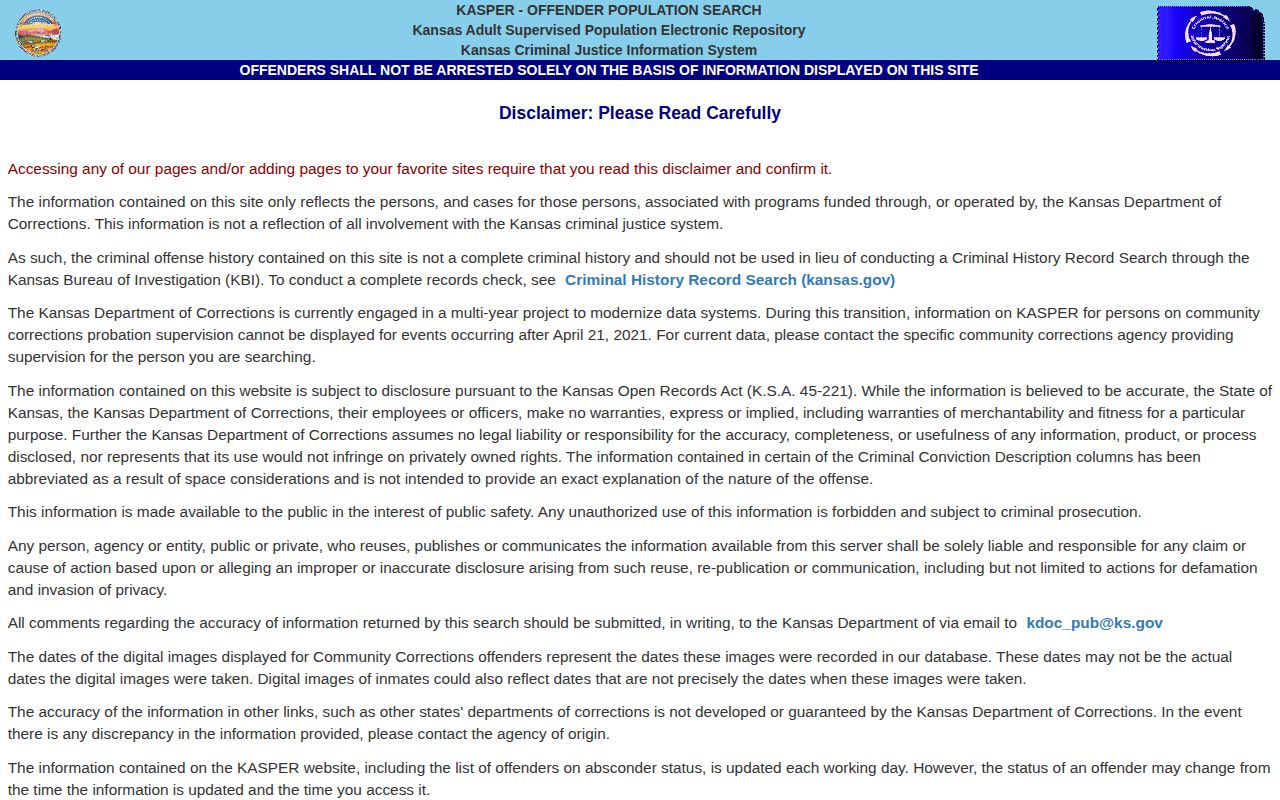
The screen helps narrow a match, but a current agency record or written KDOC response is stronger proof when status matters.
Smith County Release Court Records
Smith County release research can split between two courts. State cases belong to the Seventeenth Judicial District and can appear in the Kansas District Court Public Access Portal. Search by party or case number and filter to Smith County. Bond orders, docket events, pleas, judgments, sentences, revocations, and dismissals can explain why detention authority changed. The court order may not show the precise hour the jail completed release processing.
The official district-record instructions distinguish online portal access from records available only at courthouse terminals. Sealed, expunged, adoption, many juvenile, child-in-need-of-care, grand-jury, and protected records do not appear through ordinary public search. The portal’s Smith County controls are visible below.
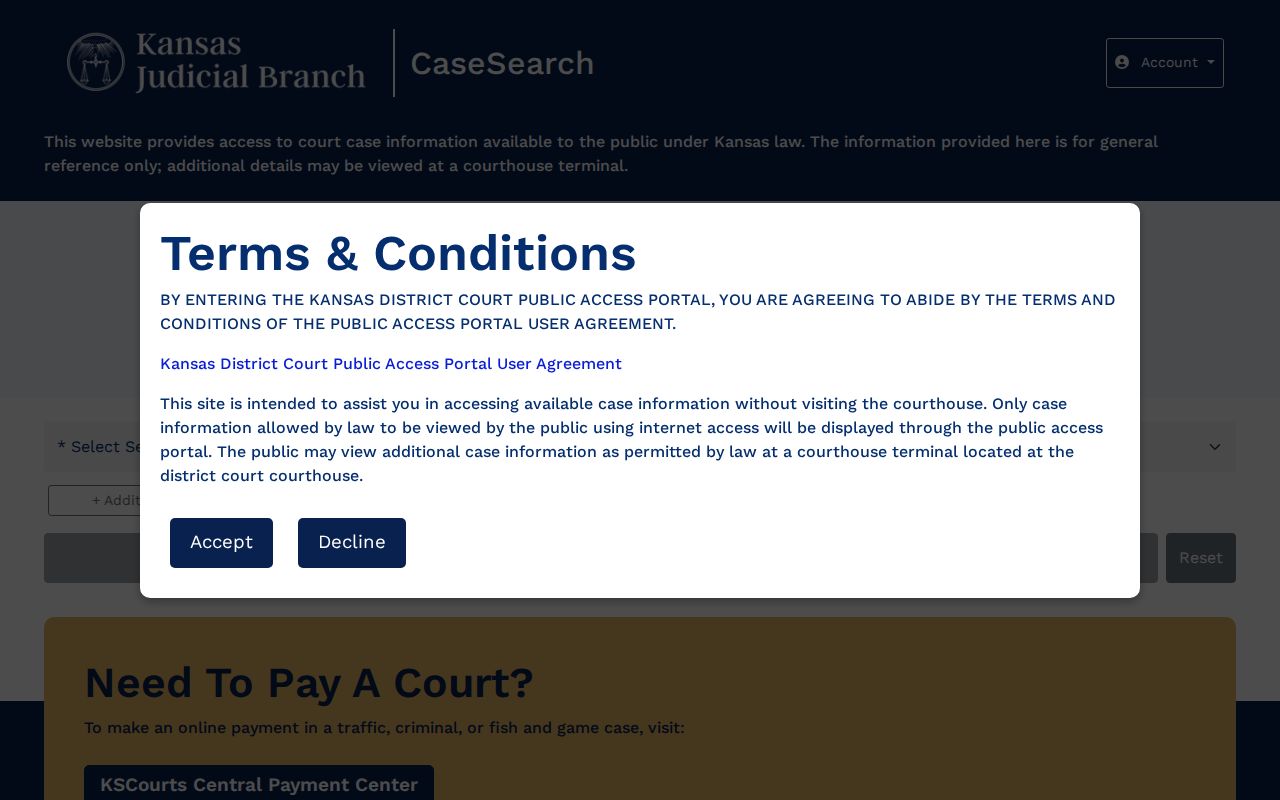
City matters take a different route. Smith Center Municipal Court generally meets on the third Thursday of each month at the Srader building unless otherwise stated. If the release authority is unclear, ask the jail for the case number and court name before searching.
Smith County Post-Release Supervision
KASPER can show parole, conditional release, postrelease supervision, or discharge for a KDOC case. Smith County supervision is routed regionally to Northwest Kansas Community Corrections, 117 E. 13th St., Hays, KS 67601, at 785-625-9192. The assigned office can change with residence or an interstate transfer, so check KASPER before calling.
- Parole
- Discretionary supervised release for an eligible sentence after Board action.
- Probation
- A court-ordered community status that is legally distinct from prison parole.
- Postrelease supervision
- A required community phase following the prison part of many guidelines sentences.
- Discharge
- The later point when the sentence and supervision authority end.
There is no public statewide name list for every ordinary Kansas probationer. Use the district-court file and the proper court services or community corrections office. The fuller Parole / Probation route also explains Smith County absconder searches and the regional reporting boundary.
Smith County Release Notifications
Kansas VINE covers adult offenders in participating county jails and expressly excludes KDOC state-prison residents. Search the Kansas VINELink landing page, compare identity and facility details, and register while the person is still in county custody. A release or transfer alert is a prompt to confirm the event with the jail. VINE does not promise a permanent released-person archive.
For a KDOC prisoner or supervised person, use KASPER and the separate KDOC Office of Victim Services process. For federal prison history, the BOP Inmate Locator can show a past release date and “Released” or “Not in BOP Custody” for many records from 1982 forward. ICE’s locator covers current detainees and, under ICE guidance, releases within the prior 60 days. Neither federal tool covers an ordinary Smith County jail booking.
A county-jail departure to KDOC, BOP, ICE, another county, or another agency is a transfer until the receiving record shows otherwise.
Smith County Jail Release Times
Smith County does not publish a set release-processing hour, exit door, family waiting point, weekend or holiday schedule, property-return procedure, gate-money policy, or jail-provided ride. The Tuesday visitation period shown on the official jail page applies to visits. It is not a release window and should never be used to predict when someone will leave.
Call 785-282-5180 before traveling to the jail. Ask whether release has been authorized, whether processing is complete, and where a pickup should wait. Also ask if the recorded event is a community release or a transfer to another authority. A court order or bond payment can precede the actual custody-end time.
Getting Home After Smith County Release
Transportation should be arranged only after the jail confirms the release and pickup details. A scheduled court event, bond payment, or estimated release time does not guarantee that administrative processing is complete.
Smith Center’s Community Connection transportation operates demand-response trips throughout the city and county, plus trips up to two hours away, Monday through Friday from 8:00 a.m. to 4:00 p.m. It is not advertised as a jail shuttle. A rider must schedule service and confirm whether the trip can meet the actual release time. Evenings, weekends, and holidays require another plan.
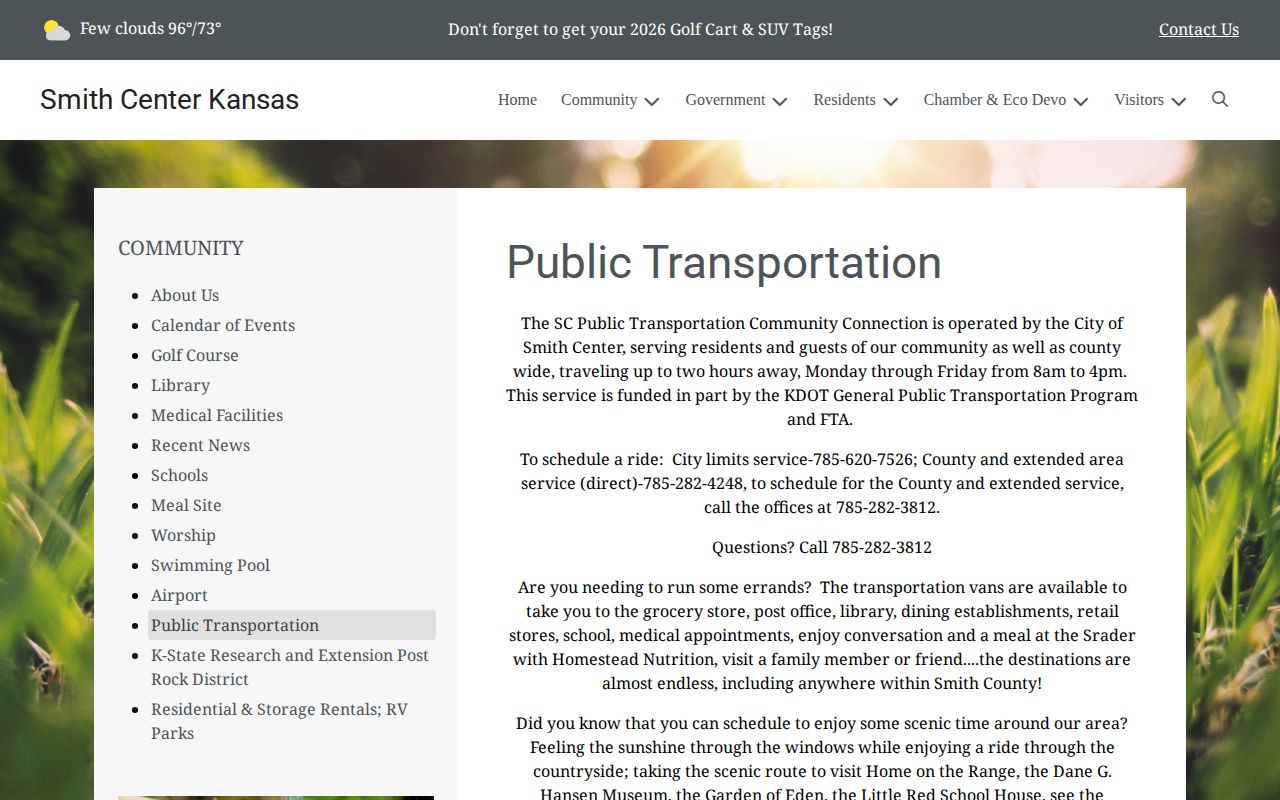
The limited service window is why release time should be confirmed before a ride is dispatched.
Smith County Bond Release Options
The official jail page distinguishes full cash bond, professional surety, own-recognizance release, and court-authorized ten-percent cash deposit. A surety agent commonly charges about ten percent as a nonrefundable fee. Agents must be approved by the Seventeenth Judicial District. The Sheriff keeps a list in the jail lobby and cannot recommend a company.
Bond-out ends physical custody only after jail processing. The criminal case stays open, and conditions may include court-services contact, travel limits, or no-contact terms. The jail states that victim-related charges carry a no-contact condition for at least 72 hours and often longer. That period is not a 72-hour release-list window.
Does payment prove release? No. A receipt or court authorization does not establish the physical departure time. Confirm execution with the Smith County Jail and obtain the custody-end entry when the exact time matters.
Compare Smith County Custody Records
Each system has a defined scope. Using the wrong one can turn a valid absence into a false conclusion.
| System | Who it covers | Best release evidence |
|---|---|---|
| Smith County Sheriff | Local jail bookings | Release entry and filed release or transfer instrument |
| KASPER | KDOC prison and supervision population | Community status, movement, expiration, or formal KDOC record |
| Kansas courts | District cases and available documents | Bond, dismissal, judgment, sentence, or revocation order |
| Kansas VINE | Participating county-jail custody notifications | Alert followed by jail confirmation |
| BOP or ICE | Federal prison or civil immigration custody | Federal locator record within that system’s scope |
| KBI registry | Only people with a statutory registration duty | Current registry status, not a universal release record |
The KBI registered-offender system can corroborate community presence for a covered sex, violent, or drug offender. Most released people are not registrants. No registry result is therefore not evidence that someone remains in custody.
Smith County Release Facilities
The Smith County Jail is the only confirmed local detention facility. It handles county custody, bond processing, local-sentence completion, and transfers. A direct release can return someone to the community, while a transfer requires checking the named receiving agency.
The Kansas Department of Corrections system is statewide and has no prison located in Smith County. A person sentenced to the Secretary of Corrections can be placed anywhere KDOC assigns. KASPER and KDOC records, rather than the county jail file alone, show prison release, supervision, and discharge.
No Kansas state prison, federal prison, dedicated ICE detention center, juvenile detention center, halfway house, or separately documented municipal holding facility was found in Smith County. Systems with the same county name in Texas must not be used for this Kansas inquiry.
Search Public Records
Sponsored Results