
Smith County Booking Photo Records
A mugshot is a photograph made during a booking or correctional intake. Physical release does not erase the source record. Yet Kansas law does not make every booking photograph automatically available. The Kansas Attorney General's KORA guidance distinguishes open jail rosters from mugshots and standard arrest reports, which an agency may discretionarily close. Smith County has no photo-bearing roster to consult after a person leaves the jail.
The photo and the release record answer different questions. A photo can help connect a person to a particular booking. The release entry, bond document, court order, or instrument kept under K.S.A. 19-1911 shows when county custody ended and the recorded legal reason. A transfer to KDOC, another county, federal officials, a hospital, or immigration custody is not the same as release to the community. Ask for both records when that difference matters.
Smith County Released Mugshot Channels
Choose a photo channel by custody history. Local arrest, KDOC imprisonment, and statutory registration create different images. One should not be substituted for another.
| Channel | Photo availability | How to access it |
|---|---|---|
| Smith County Sheriff | Possible, not guaranteed | Request the specific booking photograph by name and booking date. |
| County roster or release feed | None published | Smith County offers no roster, archive, or recent-release photo gallery. |
| KASPER | Often for KDOC records | Accept the disclaimer, search the correct person, and use the photo display option. |
| KBI offender registry | Current image for covered registrants | Use only when the person has a statutory registration duty. |
| Official social or news notice | Occasional | Check a specific incident notice, not an assumed regular feed. |
| Commercial pages | May be copied or stale | Do not treat them as proof of identity, custody, or release. |
VINELink can provide county-jail custody status and notifications, but Kansas does not promise a permanent released-person photo archive there. Court records may confirm the case and disposition, though they are not a dependable photo source. A source image must always be reconciled with a name, date of birth when available, booking or KDOC number, and the relevant case.
No Smith County Mugshot App
The official Smith County Sheriff's page links to an official Facebook account, but it advertises no Kansas mobile app and no routine release or mugshot schedule. A similarly named sheriff app belongs to Smith County, Texas. It must not be used for Smith County, Kansas searches.
The official Facebook page may carry an incident-specific public notice. That does not turn it into a booking archive. Confirm the post came from the Kansas office, check its date, and then contact the Sheriff for the underlying custody record. No dependable local news archive or third-party released-mugshot collection was identified in the research. Categories of copied images can exist online, but those copies may have the wrong date, case status, or county.
For a recent local custody event, the Smith County released-last-24-hours process explains the direct jail and records-request fallback. There is no official recent-release feed behind that label.
Request a Smith County Mugshot
Send a focused Kansas Open Records Act request to the office that holds the booking file. The Smith County Sheriff is the logical custodian for a Smith County Jail image. Call first because the county publishes no sheriff records email, dedicated records hours, booking-photo fee, or guaranteed delivery method.
- Identify the person by full name and approximate booking date. Add date of birth, case number, or booking number if it prevents a mistaken match.
- Ask for the existing booking photograph associated with that booking. Also request the booking and release entry if release status must be verified.
- Use the county inspection or copy form if the Sheriff accepts it, but confirm the current custodian and submission channel first.
- Ask for all reasonably segregable open portions if part of the file is withheld, plus the legal basis for withholding.
- Review the estimate before paying. KORA permits reasonable actual-cost fees and advance payment, but the final amount for a sheriff photo is not published.
K.S.A. 45-218 requires action as soon as possible and by the end of the third business day. This is a response deadline, not a promise that the image will arrive in three days. An agency may explain a delay and the earliest availability. It also need not create a new photo, narrative, or custom report.
The county's general open-records policy lists copy and staff-time charges. That schedule should be confirmed for a Sheriff request before a total is assumed. The captured county page below shows the official fee source used for this route.
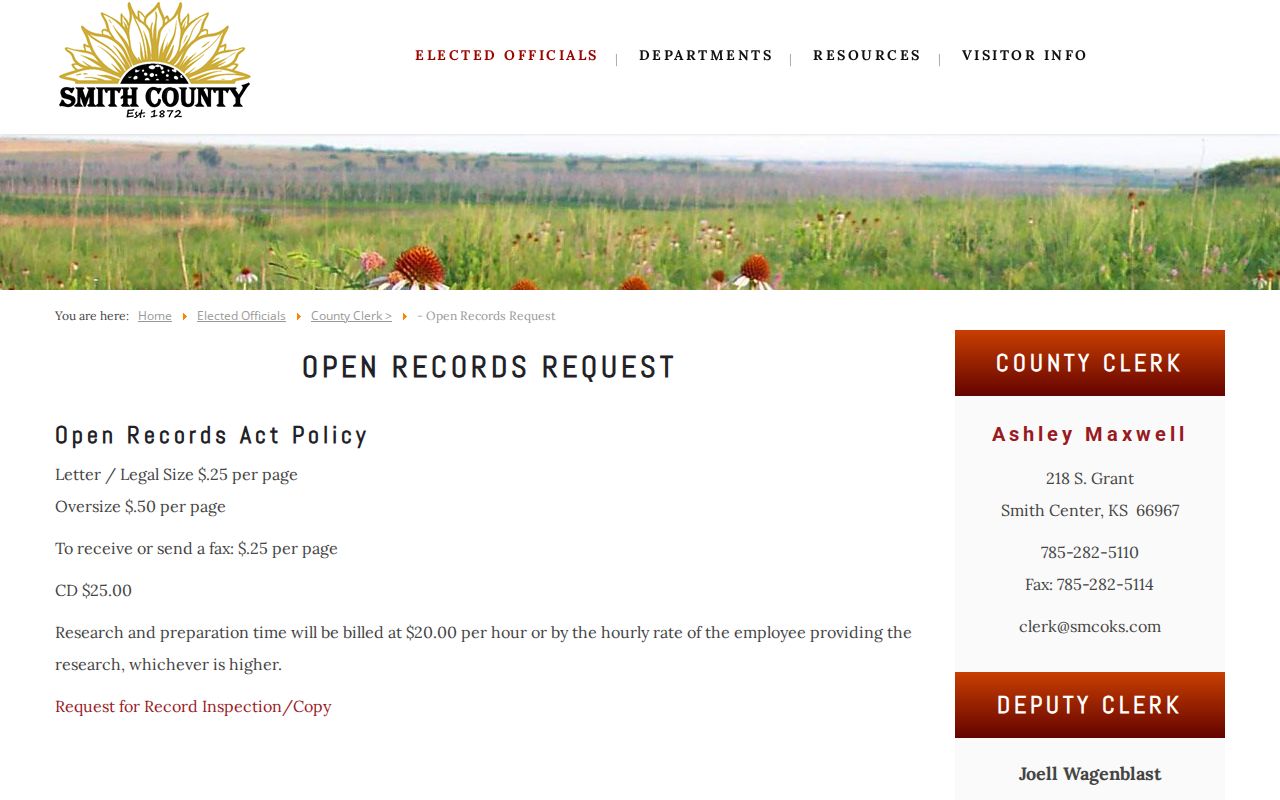
The image connects the mugshot request to the county's official records policy. It does not show that a particular photograph is open or establish a photo-specific charge.
KDOC Photos for Smith County Releases
A person sentenced in Smith County to the Secretary of Corrections can be housed anywhere KDOC assigns. The KASPER offender search covers people sentenced to KDOC custody since 1980, including current prisoners, people under post-incarceration supervision, and discharged people. It is not a Smith County jail database. Someone who bonded out locally and never entered KDOC may have no KASPER result.
KASPER offers photo display options. Search by KDOC number when possible, or narrow a name search with date of birth, alias, KBI number, or conviction county. Compare the correctional identity and sentence data before relying on an image. KDOC notes that an image database date may not be the date the photograph was taken. A KDOC photo is also not necessarily the photograph made at the Smith County booking.
When documentary proof is needed, use the KDOC GovQA records portal and request the available correctional photograph plus the movement, release, or discharge record. A community-supervision status can show that prison confinement ended while legal supervision continues. Sentence expiration or maximum discharge marks a later endpoint.
Smith County Registry Photo Limits
The KBI registered-offender search publishes a current image for people who have a statutory duty to register. The record can also include names, aliases, residence, temporary lodging, vehicles, physical description, convictions, and registry category. Kansas requires an updated photograph during reporting.
That image has a narrow meaning. It is a current registry photograph, not proof of the Smith County booking, the booking date, or the manner of release. Most people released from custody are not registrants. An absent registry result therefore says nothing about whether someone left jail or prison. KBI also cautions that fingerprint comparison is the conclusive means of identity.
Check the record's source and date before drawing any custody conclusion. Registry information can change as a covered person reports, and some public details come from the registrant. The registry is designed for its statutory purpose, while the Sheriff's release entry documents the end of local jail custody. Even when both systems show the same individual, they describe separate events. A current registry image should not be labeled a Smith County released mugshot unless the originating record actually identifies it as the county booking photograph.
Expunged Smith County Photo Records
Kansas expungement can restrict later public disclosure of arrest, conviction, diversion, or incarceration records. Conviction and diversion petitions are principally governed by K.S.A. 21-6614, while arrest-only expungement is governed by K.S.A. 22-2410. Eligibility depends on the record, outcome, offense, completed sentence or supervision, waiting period, and other statutory limits. An expunged record may disappear from ordinary public access, but an empty search does not by itself prove expungement.
No Kansas statute aimed specifically at commercial mugshot publishers or paid mugshot removal was identified in the official-source sweep. That limited finding should not be turned into a claim that copied images must remain online or that a paid service can secure removal. For an official source, provide a certified expungement order to the custodian and ask how the order applies to its records. For another publisher, review its correction process without treating payment as a guarantee.
A Smith County release record remains the proper proof of when custody ended. The site's full Smith County release search and records path explains how to reconcile the jail entry, court order, and any receiving system.