
Smith County Projected Release Meaning
Kansas uses the exact public field name Anticipated Guidelines Release Date. KDOC lists it beside parole eligibility, conditional release, and expiration of sentence. Those fields answer different questions. An anticipated date is the agency’s current sentence calculation for an eligible guidelines prison term. Parole eligibility is the date when the Prisoner Review Board may consider an eligible old-law or indeterminate case. Conditional release is a separate statutory status. Expiration is the endpoint of the sentence.
An actual release date records when physical custody ended. The anticipated date may become the actual date, but it is not a promise. Processing, a new court order, a detainer, lost credit, or another agency’s authority may change what happens. A detainer is a request or legal hold from another authority. If that authority takes custody, the person left one facility but was transferred rather than released to the community.
A pretrial Smith County detainee usually has no computed prison release date. Bond, dismissal, plea, sentence, or another court order determines when local custody may end. A person serving a local jail term may have a release calculation, but Smith County publishes no local calculator or good-time policy. The court sentence and Sheriff’s executed release record control that local answer.
Find a Smith County Release Date
Identify who has custody first. A person at Smith County Jail follows the local jail and court path. A person committed to the Secretary of Corrections follows the statewide KDOC path, even if the conviction arose in Smith County. KASPER does not cover every county booking. A local bond-out that never became a KDOC sentence may leave no state corrections record.
- For a KDOC case, open the KASPER disclaimer and accept the terms.
- Search by KDOC number when known. Otherwise use exact name and narrow the results with birth date, aliases, KBI number, or conviction county.
- Compare identity and conviction details before opening the record.
- Read current location and status, then locate the Anticipated Guidelines Release Date, parole eligibility, conditional release, and expiration fields separately.
- For a Smith County jail sentence or pending case, call the Sheriff at 785-282-5180 and check the court sentence, bond order, and credited days.
- Request the formal sentence computation or release record when an official document is needed.
KASPER covers people sentenced to KDOC authority since 1980, including current prisoners, those under post-incarceration supervision, and discharged people. It allows searches by name and KDOC number, with advanced controls for alias, KBI number, race, gender, birth date, age range, and conviction county. A number search is the safest choice when identities are similar.
The public repository is updated on working days, so a recent event can lag. A community-supervision status generally shows that prison confinement ended, but the sentence continues. “Discharged” or an expiration field points to the later endpoint. A formal record request can be made through the KDOC GovQA portal.
Smith County Good-Time Release Rules
State good-time rules apply to KDOC prison sentences, not automatically to a term served only in Smith County Jail. Under K.S.A. 21-6821, many crimes committed on or after July 1, 1993 permit a maximum good-time reduction of 15 percent of the prison portion. That is the source of the common shorthand that a person may serve about 85 percent if all available credit is earned and kept. It is not a universal rule for every Kansas sentence.
The same statute permits a maximum 20 percent reduction for specified eligible groups: nondrug severity levels 7 through 10 committed on or after January 1, 2008; drug severity levels 3 through 4 during the January 1, 2008 through June 30, 2012 period; and drug severity levels 3 through 5 for crimes on or after July 1, 2012. Eligible terms may approach 80 percent. Off-grid, mandatory, and pre-guidelines sentences can follow other rules.
K.S.A. 21-6821(e) also permits up to 120 added days of credit for eligible people serving only specified lower-severity sentences who complete a qualifying program. Examples in the statute include a GED, technical or vocational training, substance-use treatment, or another program named by the Secretary. Credits may be earned, withheld, or forfeited. For specified sexually violent or sexually motivated crimes, time removed from confinement can be added to postrelease supervision. Earlier physical release may therefore leave the total sentence end unchanged.
The official statute capture below shows the Kansas 15 percent, 20 percent, and program-credit framework.
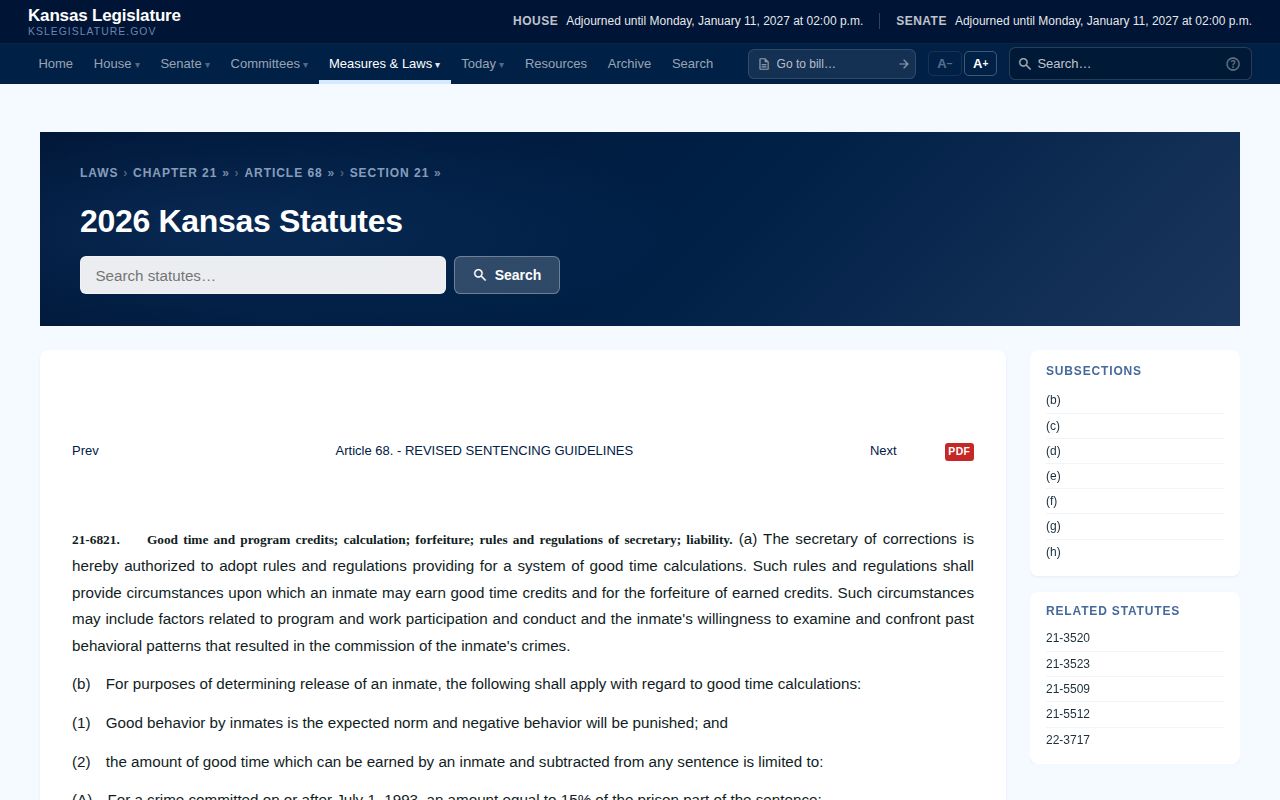
The statute supports the state calculation, but KDOC’s current person-level computation remains the source for a specific anticipated date.
Smith County Parole Eligibility Dates
Most Kansas crimes committed on or after July 1, 1993 use determinate guidelines sentences. “Determinate” means the court sets a defined prison term and a defined supervision period. Many non-off-grid guidelines prisoners are not parole eligible. They complete the prison portion and move to mandatory postrelease supervision. A projected-date reader should not be sent to the parole calendar unless the sentence is actually eligible for Board review.
Pre-July 1, 1993 indeterminate cases use older rules. “Indeterminate” means the sentence has a minimum and maximum structure. K.S.A. 22-3725 contains an older good-time table and excludes later crimes. Subject to exceptions, eligibility can reflect the judicial minimum less earned credit. KDOC describes a one-day-for-one-day structure for many minimums of two years or more, which can allow eligibility at half the minimum if all credit is earned. Eligibility permits Board review. It never guarantees release.
KDOC’s Prisoner Review Board process explains the guidelines and old-law distinction. Special rules apply to life without parole, capital murder, specified first-degree murder, class A felonies, off-grid crimes, and Jessica’s Law sentences. Offense dates and sentence structure are vital, so no single percentage or parole formula can answer every Smith County case.
- Good time
- Credit that may reduce eligible prison time when it is earned and retained.
- Parole eligibility
- The point when the Board may consider an eligible person; it is not release approval.
- Postrelease supervision
- A required community term after confinement for many guidelines sentences.
- Expiration
- The point when the controlling sentence reaches its endpoint.
Why Smith County Release Dates Move
An anticipated date changes when an input to the sentence computation changes. KDOC should be treated as the source of the current calculation, not a hand estimate made from one percentage. Sentence-begins data, jail credit, and the relationship among multiple terms can all affect the result. Concurrent terms run together to the extent ordered. Consecutive terms run one after another. A new sentence or court modification can alter the controlling term.
| Factor | Possible effect |
|---|---|
| Good-time award or forfeiture | Moves the eligible anticipated date earlier or later within the controlling rules. |
| Program credit | May reduce eligible prison time when statutory terms and completion rules are met. |
| Jail credit or sentence-begins data | Changes how much credited time KDOC applies to the sentence. |
| Concurrent or consecutive terms | Changes the structure and length of the controlling calculation. |
| New sentence or court modification | Can replace or add to the prior calculation. |
| Escape, interruption, revocation, or absconder time | May stop credit or add time under the governing law and order. |
| Warrant, detainer, or receiving agency | May prevent community release even when one custody term ends. |
Parole also requires care. A scheduled hearing does not change custody. A Board grant authorizes parole, but processing and other legal holds can still affect the physical exit. KASPER community-supervision status is stronger evidence that prison custody ended. A formal release or movement record is stronger still.
Note: Calculate nothing from the 85 percent shorthand alone; the crime date, severity, sentence type, credits, and later legal events all matter.
Smith County Jail Release Dates
Smith County publishes no local good-time policy, sentence calculator, current roster, or release-date feed. Do not import the KDOC 15 or 20 percent rules into a local jail term. Unless KDOC has authority, the local court sentence and the Sheriff custody record control. Ask the court for the sentence, bond order, and credited days. Ask the Sheriff for the executed release entry and the release instrument kept under K.S.A. 19-1911.
A pending detainee may leave on cash bond, surety bond, own recognizance, or a ten-percent deposit when authorized. The case remains active after bond release. A jail departure may also be a transfer to KDOC, another county, federal authorities, immigration custody, or another agency. Ask whether the recorded event was community release or transfer and request the receiving authority when applicable.
The Smith County Jail can be reached at 217 S. Jefferson Street, Smith Center, KS 66967, by phone at 785-282-5180. The county does not publish release-processing hours, a pickup point, or a weekend policy. Visitation hours are not release hours. Call before making pickup plans, and do not treat an estimated date as a set departure time.
Confirm Smith County Actual Release
For a state prisoner, compare the anticipated field with current status and movement information. Then request the sentence computation or release/discharge record from KDOC if documentation is needed. KDOC records may include the controlling sentence, sentence-begins date, anticipated date, parole eligibility, conditional release, expiration, movements, and supervision office. Treatment data and other protected material may be withheld.
For a county-jail case, reconcile the court order with the Sheriff’s release entry. The order supplies legal authority; the jail record shows execution. A Kansas VINELink alert can provide notice of a county-jail custody change if registration occurred while the person was held. The Smith County VINELink Release Check explains the alert and PIN steps. VINE excludes KDOC prison residents, so use the state process for them.
A final release check asks three questions: which system had custody, what authority ended that custody, and whether another agency or supervision term took over. That method avoids treating an anticipated date as a guaranteed exit or a transfer as a return to the community.